

Meghan Holohan is a freelance health journalist who covers patient-centered stories about cancer, rare disease, women’s health, cardiovascular disease, and health trends. She has won a National Press Foundation Covering Rare Disease Fellowship and an Excellence-in Features Journalism award from the Society for Features Journalism.
Many older adults struggle with keeping steady on their feet — but imbalance doesn’t have to be inevitable

Fact checked by Shannon Sparks
In season 2 of “The Pitt,” an older woman lands in the emergency department after an accident. As doctors evaluate her, they realize she and her husband are at risk of falling in their home. The doctors encourage the couple to consider assisted living, and their adult daughter agrees. Yet the couple bristles at the suggestion.
This scene highlights a problem many aging adults face: Worsening balance increases their likelihood of falling.
“The rate of falls has actually gone up,” says Adeela Cheema, MD, a geriatrician at Endeavor Health. “About 20% to 30% of U.S. adults age 65 and older report balance or walking problems annually.”
The older people are, the less steady they tend to be. Nearly 85% of people 80 and older experience balance troubles that can lead to a tumble, Cheema adds. In some ways, due to mental and physical changes, waning balance is part of growing older.
“As we age, our bodies change in so many different ways — cognitively, in muscle mass, neurologically,” says Lauren Lorensen, vice president of clinical operations at Legends Home Therapy, an agency that provides outpatient therapy at home for older adults. “It’s multifactorial why your balance may change.”
While toppling over can lead to injuries, unsteadiness also can signal other issues.
“It can be a hallmark of an underlying major issue,” Cheema says. “It could be that your blood pressure is not being maintained, and this could lead to more serious complications. It could be that you have lost so much muscle mass that common activities are becoming challenging.”
Yet balance troubles and falls are likely underreported, experts say. Many people feel embarrassed and hesitate to discuss them.
“People may omit that they have had a fall when talking to friends, family, or their medical professionals,” Lorensen says. “So many people don’t want their independence taken away.”
Falling once increases the likelihood of falling again.
“The biggest predictor of future falls is a history of falls,” Cheema says. “This is the leading cause of injury-related deaths in older adults in the United States.”
Why balance decreases with age
As people age, they lose some muscle mass, a condition doctors call sarcopenia. Legs and core muscles are critical for stability, and when they weaken, people may feel unsteady on their feet, Lorensen says. While muscle loss frequently contributes to falls, other age-related changes also play a role.
“Our brain and our reflexes slow down considerably,” Cheema says. “There’s also sensory impairments — hearing loss, visual impairments, cataracts, other things like peripheral neuropathy.”
Peripheral neuropathy is numbness and tingling in the hands and feet. It frequently results from aging nerves, diabetes, smoking, or chemotherapy. Medications can also contribute to unsteadiness.
“One of the things we look at is a term called polypharmacy — the number of medications increases your risk of falls and impairs balance,” Cheema says. “This is part of what geriatricians review.”
If a doctor notices that the combination of medications causes unsteadiness, they may recommend alternatives that manage a person’s health without compromising stability.
Can older adults improve their balance?
No matter your age, there are ways to improve balance.
“Targeted balance training interventions definitely have been shown to reduce falls by about 24%,” Cheema says. “These include things like sit-to-stand sit-ups out of the chair.”
Lorenson says several exercises help improve balance.
She encourages people to try three at-home exercises:
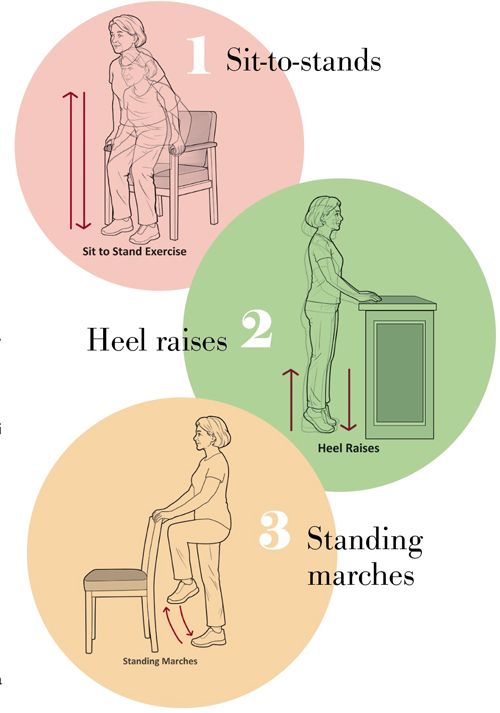 1. Sit-to-stands: Stand up from a sturdy seat, then sit down slowly, pushing off with your hands from the seat or sturdy armrests to stand again. Do this about eight to 12 times, once or twice a day.
2. Heel raises: Hold onto a stable surface, rise onto your toes, then lower back down. Repeat 10 to 15 times.
3. Standing marches: While holding onto a steady object, lift one knee at a time. Complete 10 to
20 marches.
Experts also recommend strength training to build muscle mass, which improves balance. When starting out, Cheema urges people to work with a physical therapist or trainer to avoid injury.
“When you’re looking at major muscle groups in terms of balance, your legs, your hips, and your core are probably the big areas you want to train,” Lorensen says. “Having strong arms, strong back, and shoulders, that’s good, but [balance] comes from more of your central body and your lower body.”
While many people enjoy walking as exercise, that alone does not build the strength to prevent falls.
“If we’re just talking specifically about maintaining balance and reducing falls, unfortunately, walking has not shown great benefit,” Cheema says. “If you’re walking three or four times a week, make sure you have some kind of resistance training or balance training two or three times a week.”
Originally published in the Summer/Fall 2026 print issue.