Aaron is a reporter based in the Chicago area who specializes in environmental and/or technology issues. He doesn’t understand the difference between mostaccioli and baked ziti; thinks it might be a marketing scam.
Indiana University Northwest course offers older adults digital training, building confidence and inspiring change
Joyce White thought she’d have her PhD by now. But technology kept getting in the way.
As part of the work for her degree, White, who is 72, was meeting with people and recording audio of the interviews for her dissertation project at the Institute for Clinical Social Work in Chicago.
“Then, partly because of Covid, all the tech changed. You had to do [the interviews] over Zoom, copy and transcribe everything. It was a little intimidating. I found myself rewriting and rewriting my proposal just so I didn’t have to go to the next step of using all this technology.”
Now, after completing a computer skills course for seniors, White feels ready to jump start her PhD research again.
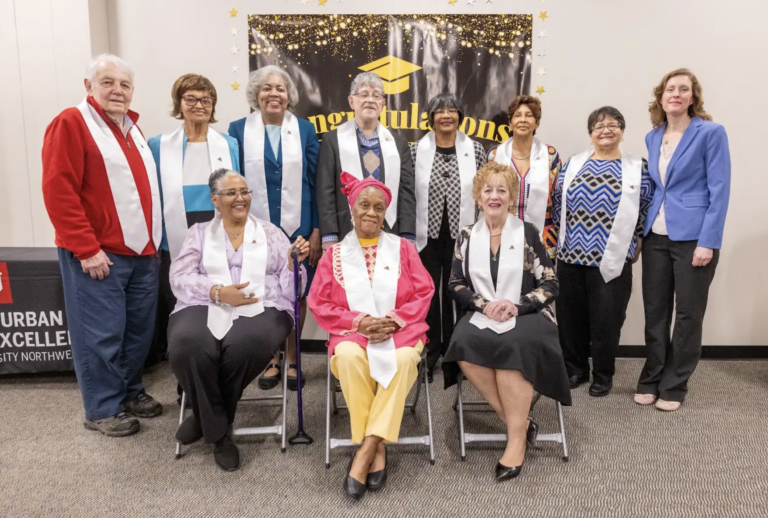
White was one of 10 graduates of a twice-weekly, five-week pilot program at Indiana University Northwest’s Center for Urban and Regional Excellence (CURE). The course, Chrome Essentials, wrapped up this past spring and was designed to teach older adults how to use a Chromebook through hands-on instruction covering artificial intelligence, search engines, email, and other digital skills.
“I felt like I had this mindset that if I have a [tech] problem, I’d have to call my grandchild to come help me. Now there’s this feeling of, if I have a problem, I can actually fix it myself,” White says.
Many participants remain in the workforce or volunteer in roles where digital skills are increasingly important.
The program also emphasized in-person learning to foster social interaction among participants.
“Loneliness is a major issue with seniors,” says Amanda Smith, CURE’s assistant director. “Social isolation, living on your own without a solid social network. Your smartphone, computer, or tablet — it can definitely become an escape or [a source of] solace. We really wanted to make sure the participants could meet in person.”
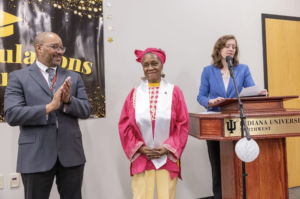
Graduate Ayanna Wright enrolled in the class to help promote her Gospel radio show. She initially learned about the program from her late minister. “Being with all the individuals there, it was a safe learning experience, very supportive. I realized seniors are just as capable of incorporating new tech into their lives as anyone else,” Wright says.
She adds that she was surprised by how much she learned, including how to avoid scams.
“All of us have a scam story,” Wright says. “I had somebody call who sounded just like my grandson. He said he was in Vegas and had a situation, couldn’t talk to his mom, but could I send some money?”
Suspicious of the story, Wright called her grandson’s mother and learned that her grandson was at home, fast asleep — far from Vegas.
In addition to avoiding scams, the students learned how to spot AI-generated misinformation and to evaluate websites’ credibility.
White describes the class as “very freeing.” She says it changed her mindset about technology from a barrier to her success into a tool for creativity.
“There was always this fear for me, when I get a new laptop or computer: Am I going to press the wrong button? Wipe everything out? It made it hard to explore anything. I felt like the class really got me over that hump,” White says.
IU Northwest’s Senior University program has grown significantly since it began in the early 2000s. What started as an intermittent summer camp over a few weeks has expanded into year-round programming, including the recent pilot course offered in partnership with AARP’s Senior Planet.
Smith says the next step will be to follow up with participants in a few months to determine which devices would most benefit older adults. She also hopes more companies will donate retired laptops that can be reused at senior centers for learning.
“With this course, we were really about to ‘take the show on the road,’” Smith says. “Go off campus to partner with a library or senior center. We’ve been running lectures, and workshops, but we’ve never done something this extensive before. It was a really exciting experience.”
If you or an older adult in your life could benefit from a technology course, check your local library, community college, or senior center for available programs. And if they don’t offer one yet, let them know there’s interest.