Ros Lederman, a freelance writer and fact checker, has been writing since she could put a pen to paper, back when that was what “writing” meant. She pursued all forms of writing through graduate school, finding her home writing about all things medical and healthcare. She also branched out into the world of digital accessibility, driven by passion and personal experience living with disabilities.
Understanding the history of July’s Disability Pride Month
Take a moment to close your eyes and imagine someone with a disability. Who do you envision? What accommodations do they have? Many people associate disability with physical disabilities. They might picture a wheelchair user because of the well-known International Symbol of Access — the figure in a wheelchair. In fact, most disabilities are invisible.
In Chicago, 1 in 4 adults has a disability. That matches the nationwide rate but exceeds the global estimate of 1 in 6 people.
Regardless of the type of disability, people with disabilities frequently face barriers to basic rights, including accessible housing, education and employment. Recent legal actions also threaten to undo decades of progress for people with psychiatric or mental disabilities who choose in-home or community-based care instead of institutionalization.
Despite these challenges, July’s Disability Pride Month honors the movement’s roots while celebrating the culture, identities, and contributions of people with disabilities.
Disability Pride’s origins
The Disability Pride movement began in 1990, the year that George HW Bush signed the Americans with Disabilities Act into law. Boston held the first Disability Pride Day that same year. The celebration eventually expanded from a single day to a month. Chicago hosted the nation’s first Disability Pride Parade in 2004.
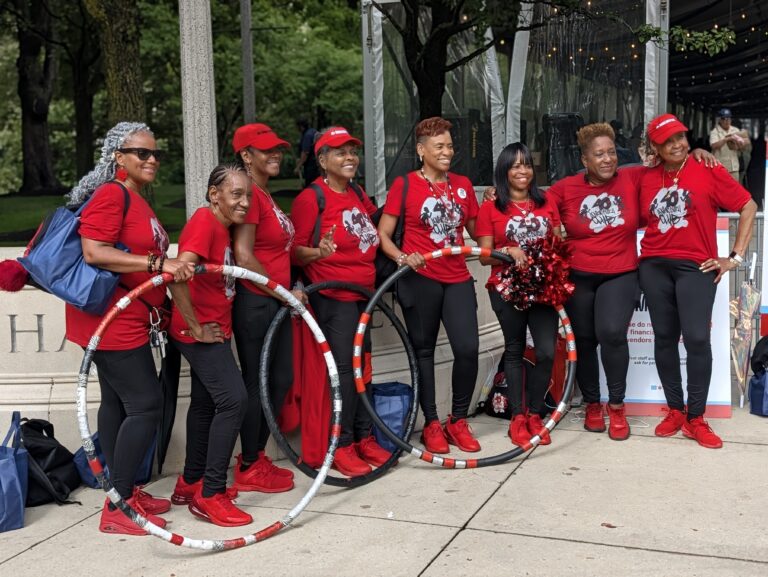
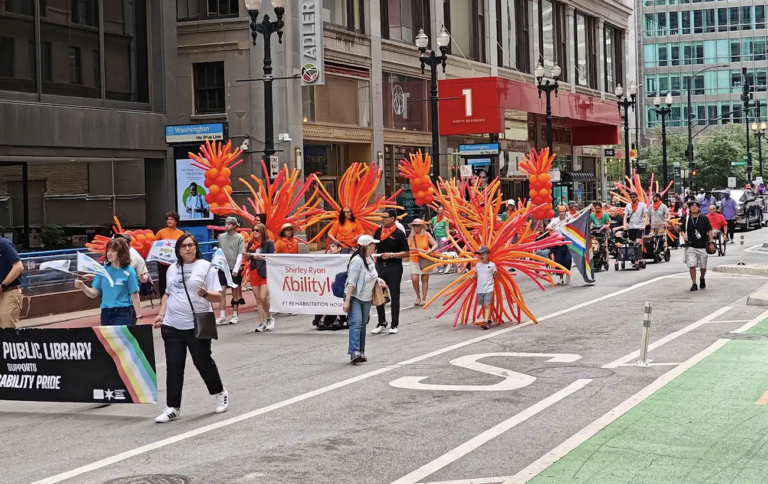
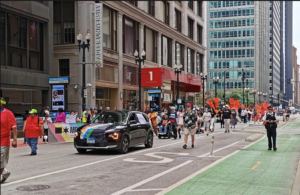
Erika Randolph, founder and CEO of Visionaries Services NFP, attended this year’s 23rd Annual Disability Pride Parade this past weekend. Randolph runs a nonprofit dedicated to helping blind and low-vision individuals in the Chicago area maintain independence by providing mentoring, counseling, and training for empowerment skills.
“The city is doing a great job in establishing a department dedicated to helping people with disabilities and providing services to support them,” Randolph says.
 In 2019, Ann Magill, a writer who has cerebral palsy, created the first Disability Pride flag. It has since evolved to feature five diagonal stripes on a faded black background. Each colored stripe represents a different aspect of disability:
- Red: Physical disabilities
- Gold: Neurodiversity
- White: Invisible and undiagnosed disabilities
- Blue: Psychiatric and emotional disabilities
- Green: Sensory disabilities
The faded black background represents both mourning and rage over victims of ableist abuse and violence.
Chicago’s history of disability rights — and wrongs
While Disability Pride Month is, at its core, a celebration, it also reminds us that progress has been hard-won.
- 1881: Chicago passed the “Ugly Law,” which made it illegal for people with physical deformities or disabilities to appear on public streets
- 1974: Lawmakers repealed the “Ugly Law.” Chicago was the last city in the nation to repeal such a law
- 1980: Access Living, a disability services and advocacy organization, brought the independent living movement to Illinois
- Mid-1980s: Mike Ervin, Bob Gettleman, and others successfully fought to make the Chicago Transit Authority system more accessible by adding wheelchair lifts to buses
- 1990: Following the passage of the Americans with Disabilities Act, Chicago established the Mayor’s Office for People with Disabilities
- 2004: Chicago hosted the country’s first Disability Pride Parade on July 18
- 2026: Governor JB Pritzker signed House Bill 862 into law. Effective July 1, 2027, it establishes the Illinois Department of Disability Advocacy and Guardianship
How to be an ally year-round
Disability Pride Month lasts just 31 days each year, but support for people with disabilities shouldn’t. You don’t have to lobby on Capitol Hill or organize a petition drive to increase accessibility, challenge ableism, and make a difference.
Start by looking at your own habits and who you encounter throughout your day. “It’s extremely important to support businesses owned and operated by people with disabilities,” Randolph says. “If you consider where you work or places you frequent, how often do you see people with disabilities? It’s good for everyone to help each other out and achieve the American dream.”
If someone shares that they have a disability, avoid dismissing that part of their identity by saying things such as, “I would never have guessed you had a disability” or “I don’t see you as disabled.”
Ask before offering help. Don’t assume someone with a disability needs or wants assistance. Instead, ask, “Can I get the door for you, or do you have it?”
Use the language the individual prefers. Some people prefer identity-first language (“I am an autistic person”), while others prefer person-first language (“I am a person with autism”). Follow their lead.
Communicate directly with the individual, not their friend, caretaker, interpreter, or someone else.
Participate in active allyship. Challenge ableist language and behaviors, including your own.
People with disabilities, who make up more than 25% of Chicago’s population, are as diverse as the city itself. They’re coworkers, neighbors, congregants, customers, business owners, sports fans, grandparents, students, parents, children, and friends. But first and foremost, they’re people.
A note from the writer: At Caregiving Magazine, we strive to highlight the ups of disability rights — elevating the community’s voices and shining a light on work being done to improve accessibility. But we also acknowledge the lows — areas where people with disabilities do not have equal access. As a person with disabilities, I believe it is fundamental that we acknowledge both, and that we honor not only the journey people with disabilities have traveled, but also how far we have yet to go towards an accessible world free from ableism.