
Nicholas Cozzi, MD, is an emergency physician and emergency medical services medical director based in Chicago, with a focus on pre-hospital care, disaster response, and medical communications. He is passionate about translating frontline experience into public policy and cultural understanding. Read more
Caregiving insights from an emergency medicine physician

Fact checked by Jim Lacy
There is a moment I see during almost every shift in the emergency department — quiet but unmistakable once you recognize it.
A phone buzzes at the bedside. A glance at the time. A calculation begins. School lets out in an hour.
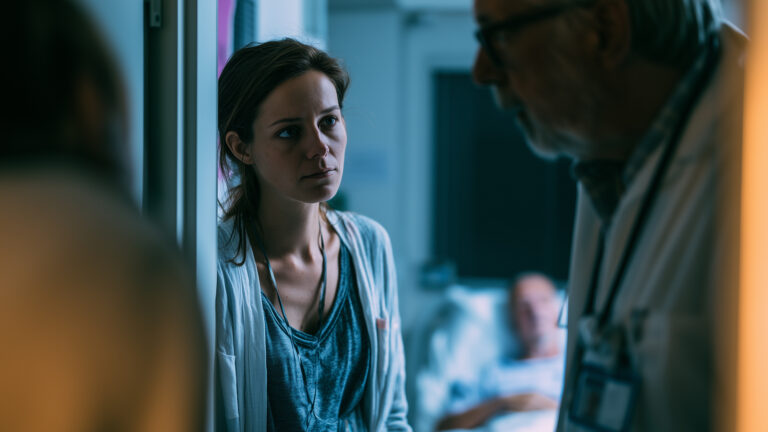
I watch as an adult child stands between two worlds — a parent in a hospital bed and a child waiting at a school door. Neither can be left unattended. Both need them completely. And yet, in that moment, the adult child is forced to divide themselves.
Caregivers arrive at the breaking point of this tension. They bring an aging parent to the emergency department, weaker than yesterday, not quite themselves. The story comes in fragments. Mom has been declining. It’s been a long time. She hasn’t been the same since Dad passed.
Beneath it all is something deeper that, if I’m quiet enough, I can hear — the words unsaid: We are trying. We just don’t know how to do this anymore.
Then comes the question: “Do you think she’ll be admitted?”
It sounds clinical, but it isn’t. Behind it, I see the math unfolding: If I leave now, I might make school pickup. But who will stay with Mom? If I stay, who picks up my kids?
At the bedside, I often notice a spiral notebook, edges worn, pages filled. Names. Medications. Questions. A pen is ready before
I even walk in. I see the way they lean forward when I speak, afraid to miss something important — because missing something feels like failing someone.
“We love our mom,” they tell me. “We’re doing our best.”
It’s a beautiful, raw thing. What strikes me most is not just the strain, but the love within it — the willingness to keep showing up, even when showing up feels unsustainable. The way people learn, in real time, how to love their parent differently.
They are not choosing between convenience and inconvenience. They are choosing between two responsibilities that both feel sacred. They are being asked to parent their parent while still being a parent themselves, and there is no training for how to do both at the same time.
There is a quiet, accumulating weight to caring for aging parents. It builds slowly — appointment by appointment, fall by fall, call by call in the middle of the night. For many, it unfolds during the same years they are raising their own children.
As an emergency physician, I see these realizations happen abruptly, often when we discuss their parents’ goals of care — a conversation that may not have happened with their parents in decades. Caregivers are busy keeping up, and the weight of these decisions often presses down on their shoulders. Would they want CPR and a breathing tube?
I see the angst of that decision weighing on their shoulders. The question is almost as overwhelming as the answer.
They pack lunches in the morning and manage medications at night. They attend school events and coordinate sub-specialty appointments for acute issues, often with the only available appointment slots months away. They help their child with homework via FaceTime while they sit bedside in a crowded emergency department hallway.
Somewhere in between, they try to hold onto themselves.
Caregiving doesn’t disappear; it transforms.
This is a season no one prepares you for. The roles have shifted, quietly but completely. The person who once carried them is now the one being carried.
And still, they keep going. Keep showing up, again and again.
I think about them long after I leave my shift: the daughter watching the clock, the son holding the notebook, the quiet sentence, almost whispered: “We’re doing everything we can.”
And they are. Not perfectly. Not without doubt. Not without cost.
The cost is not just financial, though the bills are staggering. The full cost is measured in something harder to name: the weight of knowing you want to give more than you can. The moment you realize love alone is not always enough to meet the needs in front of you.
I see it most clearly in the caregiver who brings their parent to the ER after reaching that point — exhausted, eyes heavy, carrying the quiet recognition that they could not do it alone anymore. They tried. It did not work. But they showed up.
I remind them when I can that what they are carrying, in this space between generations, is more than anyone can see. That is not failure. This is just what love looks like here.