A narrative nonfiction writer and healthcare journalist, Ellen focuses on mental health parity, policy, and aging. For this issue, she partnered with Caregiving Editor-in-Chief Katie Scarlett Brandt to cover grandparents raising their grandchildren, and how opioid settlement funds may help meet their needs.
An award-winning journalist, Katie has written for Chicago Health since 2016 and currently serves as Editor-in-Chief.
The opioid epidemic has left older adults to raise a new generation of children. Can they find support through opioid settlement funds?

Fact checked by Ros Lederman
Laurel Exner’s 16-year-old son, Adam Whited, didn’t want medication when diagnosed with multiple sclerosis, but by age 20, he needed pain relief. His dosage climbed from 10 mg to 60 mg of oxycodone as he edged toward addiction.
His physician helped him back down to 10 mg, but when his prescription ran out, he begged a friend for help. He overdosed in April 2022, leaving behind a wife and two children.
That wouldn’t be the family’s only tragedy. Exner’s daughter, Deanna, had been sober for two years before her brother’s overdose. Deanna had developed a substance use disorder while trying to self-medicate for anxiety and depression. She was raped and gave birth to a son in 2020 as Covid-19 raged.
“The baby has been in our lives since day one,” Exner says. “I cut his cord; I was there with her the whole time she was in labor.”
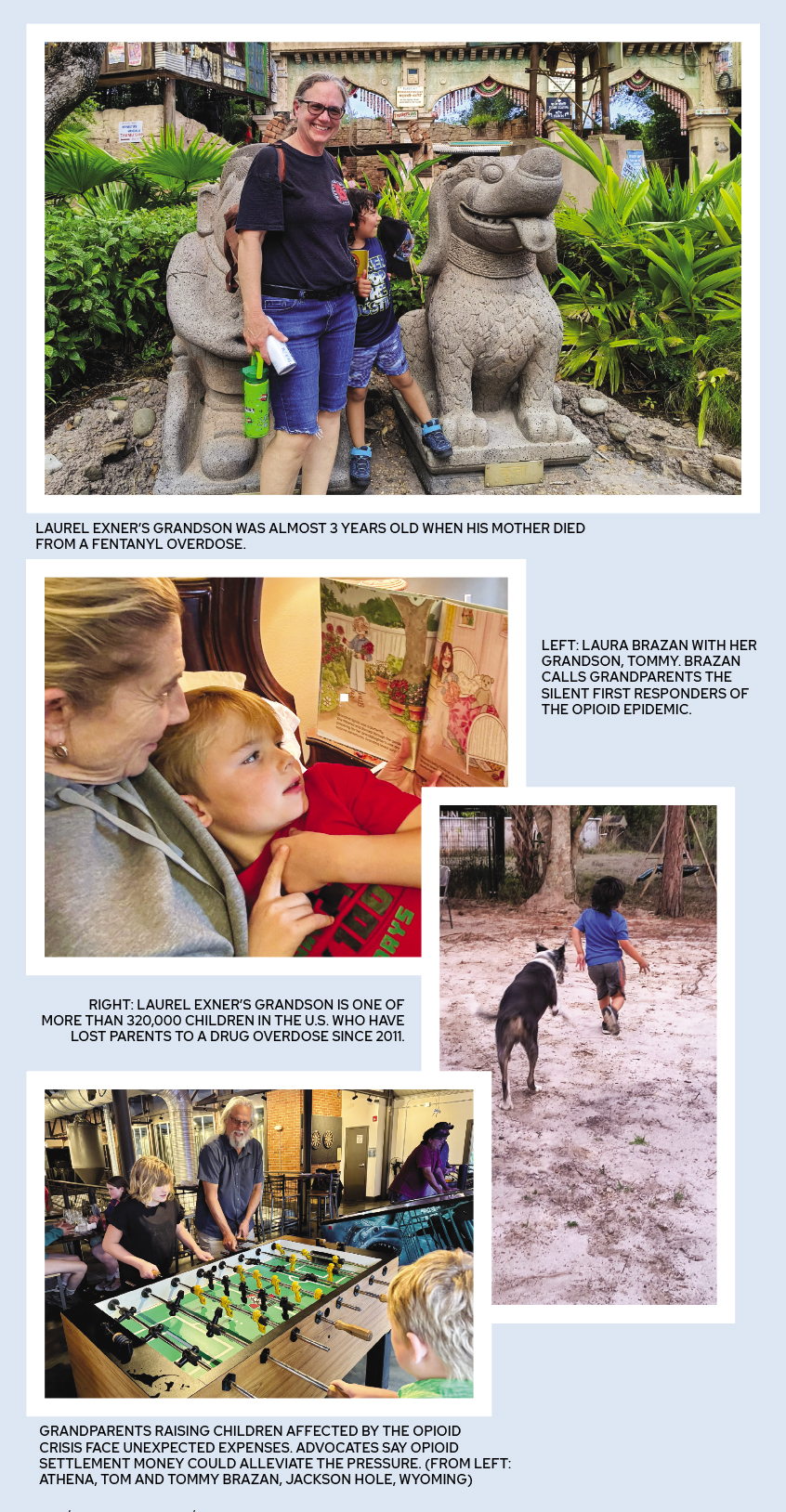
Deanna relapsed, then got sober again, and stayed sober for nine months before her overdose. She died in 2023 from fentanyl, in the same house where she, her parents, and her almost-3-year-old son lived.
Exner didn’t want her grandson to go into the foster care system, even for a night. So she became Mom, leaving any notions of grandparent life to daydreams.
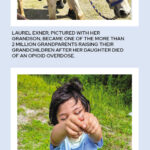 Exner, of Naples, Florida, is one of more than 2 million grandparents nationwide who are raising their grandchildren, saving the child welfare system $10.5 billion annually. Increasingly, families have found themselves in this position due to the opioid epidemic. From 2011 to 2021, 321,566 children in the United States lost a parent to drug overdose, researchers reported in a 2024 study in JAMA Psychiatry.
The crisis began nearly three decades ago, when pharmaceutical companies started pushing prescription opioids as safe and nonaddictive. Yet, from prescription opioids, many people easily transitioned to fentanyl and heroin. Some 70,000 people in the U.S. died of drug overdoses in 2025, down 14% from 2024.
As grandparents raising their grandchildren navigate the grief of losing their own children, they’re often dealing with the practicalities of having grandchildren in school and trying to address everyone’s mental and physical health.
“This is a community that has a lot of shame, a lot of guilt,” says Laura Brazan, who is raising her granddaughter and grandson in Louisiana with her husband, Tom. Brazan also hosts the “Grandparents Raising Grandchildren” podcast.
Grandparents are the silent first responders of the opioid epidemic, she adds. In some cases, grandparents are ousted from their senior living facilities when they take in their grandchildren. Many return to work or dip into their retirement funds to cover higher grocery bills, school costs, and recreational activities.
“We have one car because we can’t afford two cars. We don’t go out to eat, and our kids cook with us. We can’t afford babysitters very often,” Brazan says. “Our family has become a real core family, and we’re there for those kids. They bring us a lot of joy.”
Yet, many families wonder, as they see states receiving opioid settlement funds into the billions, about the discrepancy between governments’ compensations and their own.
Money to address the opioid epidemic
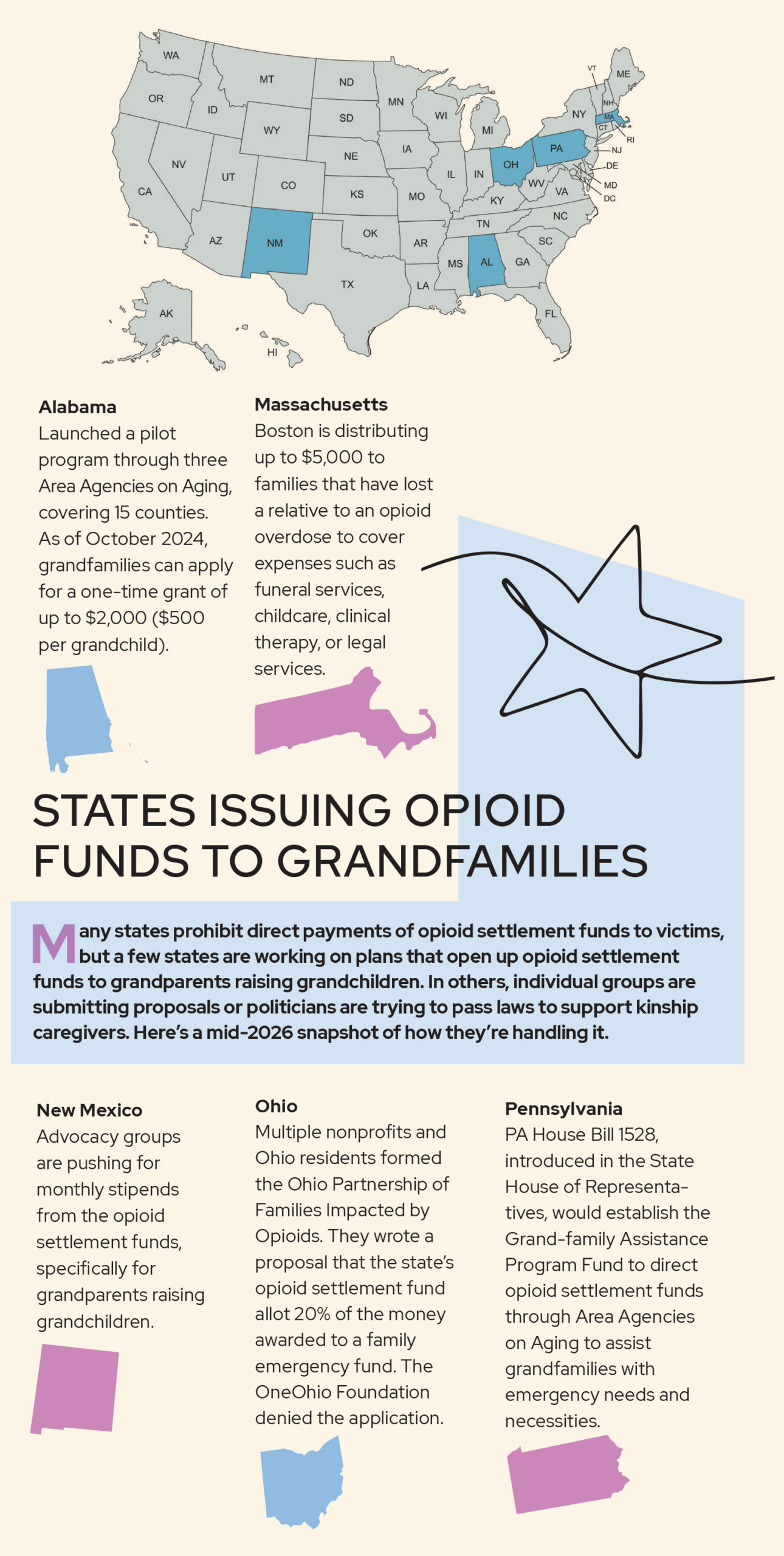
A handful of states are looking to opioid settlement funds to help address grandparents’ financial challenges and worries. The greatest financial strain often comes from meeting basic needs, according to Najah Bhatty, a social worker who facilitates the Grandparents Raising Grandchildren program at the North Shore Senior Center in Northfield, Illinois. Families often need help paying for housing, utilities, and food.
Cristina Diaz, caregiver program coordinator with suburban Cook County’s area agency on aging, AgeOptions, says, “They’re very concerned with the high price of everything. Inflation, the SNAP cuts — especially the SNAP requirements and the SNAP age changes for the kids under their care — are really going to impact folks, unfortunately.”
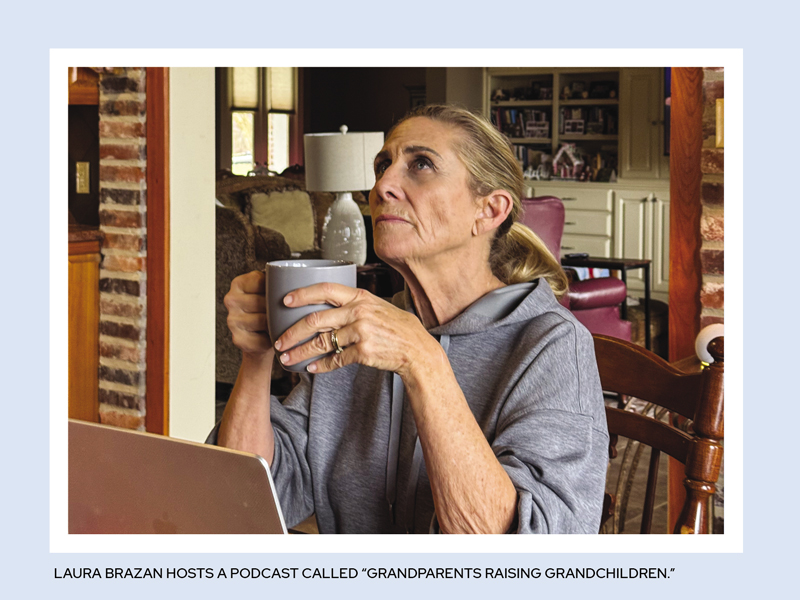 Money to address the ongoing opioid epidemic comes from the companies that profited most during the opioid crisis. Cardinal, McKesson, and AmerisourceBergen — the nation’s three major pharmaceutical distributors — and opioid manufacturer and marketer Johnson & Johnson settled their lawsuits in 2022 for$26 billion. In May 2026, Purdue Pharma and its owners, the Sackler family, reached an additional $7.4 billion settlement for their role in the epidemic.
Advocates say decision-makers often overlook the needs of grandparents raising grandchildren when distributing opioid settlement money.
“While the settlement funds are often directed toward treatment and law enforcement, the hidden cost is being absorbed by the grandparents who have stepped in overnight to raise children left in the wake of this crisis — often with zero financial or systemic support,” Brazan says.
Brazan says unexpected medical expenses for her grandchildren have put enormous financial pressure on her. “They had Medicaid when we got them, but transferring their Medicaid from Texas to Montana took six months of being on the phone every day, getting different answers every time I called, never being able to speak with the same person,” Brazan says.
Her granddaughter needed seven teeth pulled — an amount that required anesthesia. “The costs out of the packet would have been astronomical,” Brazan says. But even with Medicaid, the Brazans don’t receive compensation for travel expenses or gas. The couple spent nearly three hours a day trekking to school, appointments, and therapy.
Exner’s grandson, meanwhile, needed to have his tonsils and adenoids removed — a surgery that costs the family about $6,000, even with Exner’s insurance from her job at Sam’s Club.
Organizations are working alongside grandparents for improved policies, programs, and support for families, says Generations United Deputy Executive Director Jaia Lent.
“We were concerned that as these opioid settlement discussions were happening, children and those kin caregivers were really being left out of many of the discussions about how to use the resources,” Lent says. “So, we put together a resource and have been convening a group of caregiver advocates that have been seeking to raise awareness about the impact of opioids on their families.”
The resource guide offers specific steps to advocate locally for the inclusion of grandfamilies or kinship families in opioid settlement fund allocation. Steps include researching how funds are managed in a specific state, attending public meetings, making a funding pitch, writing a letter to local politicians or newspapers, and connecting with allies.
In February 2025, Elizabeth Mateer, a grandmother in Pennsylvania who is raising her grandson due to her daughter’s substance use, followed those steps. She testified before the U.S. Senate during a hearing on older adults and the opioid epidemic. She called grandparents raising grandchildren “one of the least recognized populations impacted by the opioid crisis.”
Mateer revealed in her testimony that she and her husband had spent years staging interventions and entering their daughter into treatment facilities. Opioid addiction, Mateer says, “takes a person’s soul and turns them into someone you don’t even recognize. We were desperate to save both mom and baby.”
Now, she says, “Our retirement is nothing like we thought it would be, driving the middle school carpool and hosting the baseball team picnic. We hope to stay healthy so that we can be there for our grandson.”
Like so many grandparents in this situation, their hope runs alongside their worries.
“The umbrella of my family”
Each state receives a different amount of the opioid settlement funds, depending on the number of people impacted in that state. Georgia’s share of the opioid settlement is $636 million, distributed over 18 years through the state’s opioid abatement fund. Regional advisory councils make initial decisions on grant applications, but there is no formal process for allocating funds to affected grandfamilies.
Patricia Lawrence serves as the director of Project Healthy Grandparents (PHG), which has been based in the Atlanta area since 1995. The community-based research study provides a one-year intervention for grandparents raising their grandchildren. In 2025, PHG provided 510 healthcare hours; 591 referrals for critical needs, legal counsel and childcare; 400 social work hours; 164 tutoring hours to grandchildren; 83 mental health sessions; and 64 parent education sessions.
As state and federal funding dwindles, Lawrence says one of the state contracts funding PHG was cut by 40% in the past year, but she says she plans to apply for a grant through the opioid abatement trust “because a percentage of our grandchildren do end up with their grandparents because of opioids.”
When she first learned about the application process, she says, “It was just too short notice for me to pull something together, but my hope is to try and apply for some funding when that cycle opens up again in 2026.”
Illinois’ share of the settlement funds is $1.4 billion by 2038. The money is divided among the Illinois Opioid Remediation Trust Fund (55%), the state (20%), and Illinois local governments (25%).
So far in Illinois, no groups have proposed grants to fund grandparents raising their grandchildren due to the opioid epidemic. Many families say they could use the help, including Skokie, Illinois, resident Cora Galbreath, who has raised a dozen of her grandchildren and is still working at age 75 to support herself and the three currently living with her.
“I’m the umbrella of my family,” she says.
Galbreath remembers the day 20 years ago that her caller ID showed the Chicago Police Department. “When I saw that number come up, I was scared because I knew something had happened,” she says.
The officer on the line asked if she was the grandmother of an 8-year-old boy and his 4-year-old sister. “We’re going to bring you the kids because their mother is in no shape to take them,” Galbreath recalls the officer saying.
“The moment when [the children] arrived, they were all happy because I’ve always been in their lives. But you never know what these kids go through,” Galbreath says.
She has 36 grandchildren and 12 great-grandchildren, many of whom she’s raised. She worries about the trauma they’ve been through and the genetic conditions they may have inherited. “Some of the challenge is just being there,” she says. “The great-grandkids and grandkids, if they ever need me, I’ve got to be there.”
She’s grateful to God, she says, but the responsibility is tough on her. “It’s very hard, just to see them suffer,” she says.
“We thought it would be temporary”
For Brazan, that grief also includes herself. She and her husband relocated more than 2,300 miles from a home they’d built on the edge of a national forest in Montana to Louisiana, where they’re closer to Brazan’s husband’s family.
“My husband is grieving the absence and inability of his son to care for his children,” Brazan says, adding that they’re also grieving the loss of their retirement.
When they first took in their grandchildren, ages 3 and 7, the kids had never worn seatbelts, had no boundaries, didn’t go to sleep at normal hours, and were covered in bugs and dried feces. “When we took them, we thought it’d be temporary,” Brazan says.
She and her husband were living in Montana at the time, 45 minutes away from a small town. They enrolled the children in a three-room schoolhouse but soon realized they needed more support. “So we had to change our whole retirement picture, which a lot of people do,” Brazan says.
She says she had been excited to take in the children at first, thinking she would bring them home, provide warm food and beds, and keep them clean. They would be so thankful and happy, she thought.
“Well, that’s not what happens,” Brazan says, four years later. “There’s a lot more involved. I’d never experienced raising children who have been through trauma.”
Though she grieves, she doesn’t complain. “There’s something about sacrificing for others that really does make you stronger.”
For their first three years together, Brazan says that doing the right thing kept her motivated through navigating school support plans, the children’s mental health and behavioral challenges, and isolation from her peers. Now, her perspective has shifted.
“Being able to have an opportunity to change a child’s life, to change the trajectory of a person’s life, I can’t think of anything I’d rather do,” Brazan says.
Brazan channels that sense of purpose into her podcast. “I need to share all of this pain I’m going through with others, and I need to share the research and the experts and the stories so that people don’t feel alone,” she says.
Otherwise, worry, fear, and the unknowns could easily overwhelm her. For Brazan, those worries come up as questions: Am I going to be able to do this? What happens when I’m gone? How do we build trust after their sense of safety, right and wrong, and love have been so corrupted?
“Which is why we moved to an area where they had lots of cousins and lots of aunts and uncles and people that come over all the time — so they feel connected,” Brazan says.
She worries about a major illness affecting her or her husband, and about the physical toll of aging. “We can’t crawl around on the floor, and we can’t always run and play baseball,” she says. “But I’ll tell you, it makes you age quicker, and it keeps you younger at the same time.”
In Skokie, Galbreath knows that worry. She grew up in Louisiana — Brazan’s new home — raised jointly by her mother and grandmother.
She remembers church on Sundays and picking cotton and corn for $3 a day.
“My grandmother did not play,” Galbreath says. “We had our own farm. We worked very hard. We did it all.”
Galbreath is still working hard and doesn’t plan to stop any time soon. She rattles off a list of grandchildren who “graduated right out of my house. I try my best; I really do,” she says. “It’s by the grace of God that I could have been one of those kids.”
And in Florida, Exner’s grandson is preparing to start kindergarten in August. She worries about his ability to sit still in class, but his preschool teacher has assured her that’s normal for his age, that he’s doing just fine.
This story was written with the support of a journalism fellowship from The Gerontological Society of America, The Journalists Network on Generations, and The Silver Century Foundation.