

Erika Hobbs is an award-winning journalist, newsroom leader, strategist, storyteller, and coach based in Chicago. As an independent journalist, Erika has written about tackling breast cancer, healthcare inequities in people of color, undocumented immigrants in the Chicago suburbs, and the power of yoga in combating the aging process. Read more
How technology supports independence and connection

Fact checked by Jim Lacy
Whether you’re a caregiver or you’re aging in place, there’s a lot to keep track of, including chores, medication, and appointments. Sometimes you need directions. Other times, you need to find someone who’s lost.
Technology, of course, offers solutions. “I think there are a lot of ways tech can make aging easier,” says Amelia Hay, vice president of startup programming and investments at The AgeTech Collaborative at AARP.
Digital tools now support people across the spectrum of aging — retirees, family caregivers, and those with significant impairments. A July 2025 AARP caregiving report shows that more than a quarter of caregivers use remote monitoring to check on loved ones — double the number in 2020. Another 1 in 5 use assistive devices that help people maintain independence.
Experts say new technologies for seniors enhance wellness, support independence, fill workforce gaps, and keep people connected.
 “So many times a parent says, ‘I don’t want to be a burden,’” says Jim Kordenbrock, a gerontologist and owner of a Home Instead franchise in California. Even basic tools such as cell phones can be a “burden buster,” he adds.
For Mary O’Connor of Glen Ellyn, Illinois, staying connected matters most. “I do not consider myself a tech person at all,” she says. But her iPhone and a computer let her keep in touch with people around the world.
O’Connor uses WhatsApp to chat with friends and family in Europe and relies on email and video conferencing to keep in touch with organizations where she volunteers in Spain and Nairobi.
“I’m retired from the work that I did, but I’m busier now than when I was employed,” she says.
According to The AgeTech Collaborative, people over 50 already buy technology such as tablets and smartphones. By 2030, experts expect they will spend about $120 billion on such purchases.
That trend highlights the need to close the digital divide, says Tony LaPalio, founder and CEO of Senior Tech Support in Wheaton, Illinois. LaPalio teaches older adults like O’Connor how to use technology and helps them fix their devices.
“These folks aren’t digital natives, and love it or hate it, we’re being forced into a digital environment for almost everyone,” he says.
Adapting to that environment could make all the difference for many older adults.
“Think about how life changing it would be for an older adult to know how to use Instacart,” LaPalio says, “especially [for] those with mobility issues.”
Technology for older adults ranges from simple and affordable to sophisticated and expensive.
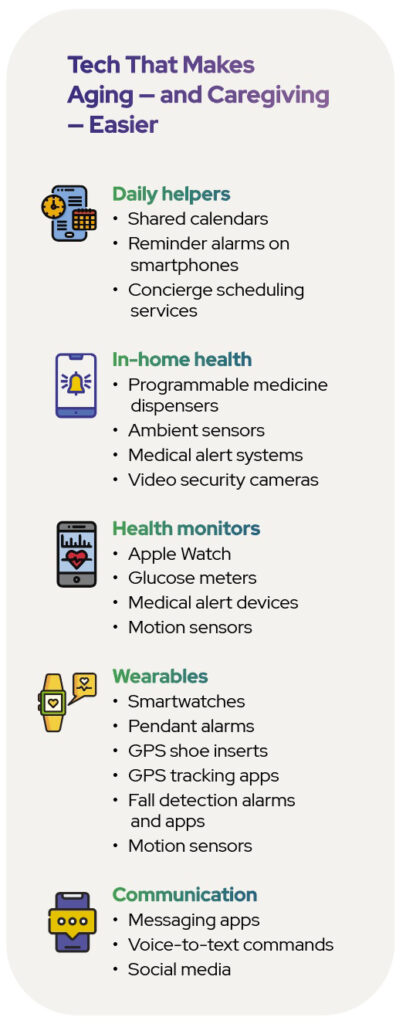
On the simpler side: cell phones. Most adults in the United States have one. An alarm on a smartphone can remind you to take your medication.
Monitoring systems are among the more sophisticated options. A home security system, for example, costs a few hundred dollars to set up and enables family members 1,800 miles away to check on a loved one — and they can talk back through the system as well.
“I personally also like wearables,” Kordenbrock says. “Anything with GPS, like watches. With some forms of dementia, people can be a flight risk, which is scary. Safety is imperative.”
Newer Apple Watch models can detect falls and monitor vital signs such as blood oxygen levels and heart rate.
Many seniors already use medical technology at home for blood pressure and glucose monitoring. Some rely on sensors that detect temperature changes, or on bed mats with alarms to alert caregivers to falls.
Tests and treatments once limited to clinics are moving into homes as well. Even ultrasounds can now be performed on site at home.
“Things are becoming portable so you don’t have to go to the doctor’s office or lab,” Hay says.
No matter how much technology you integrate into your caregiving routine, hands-on care remains essential. Technology isn’t a replacement, but it can serve as your eyes and ears when you can’t be there in person.