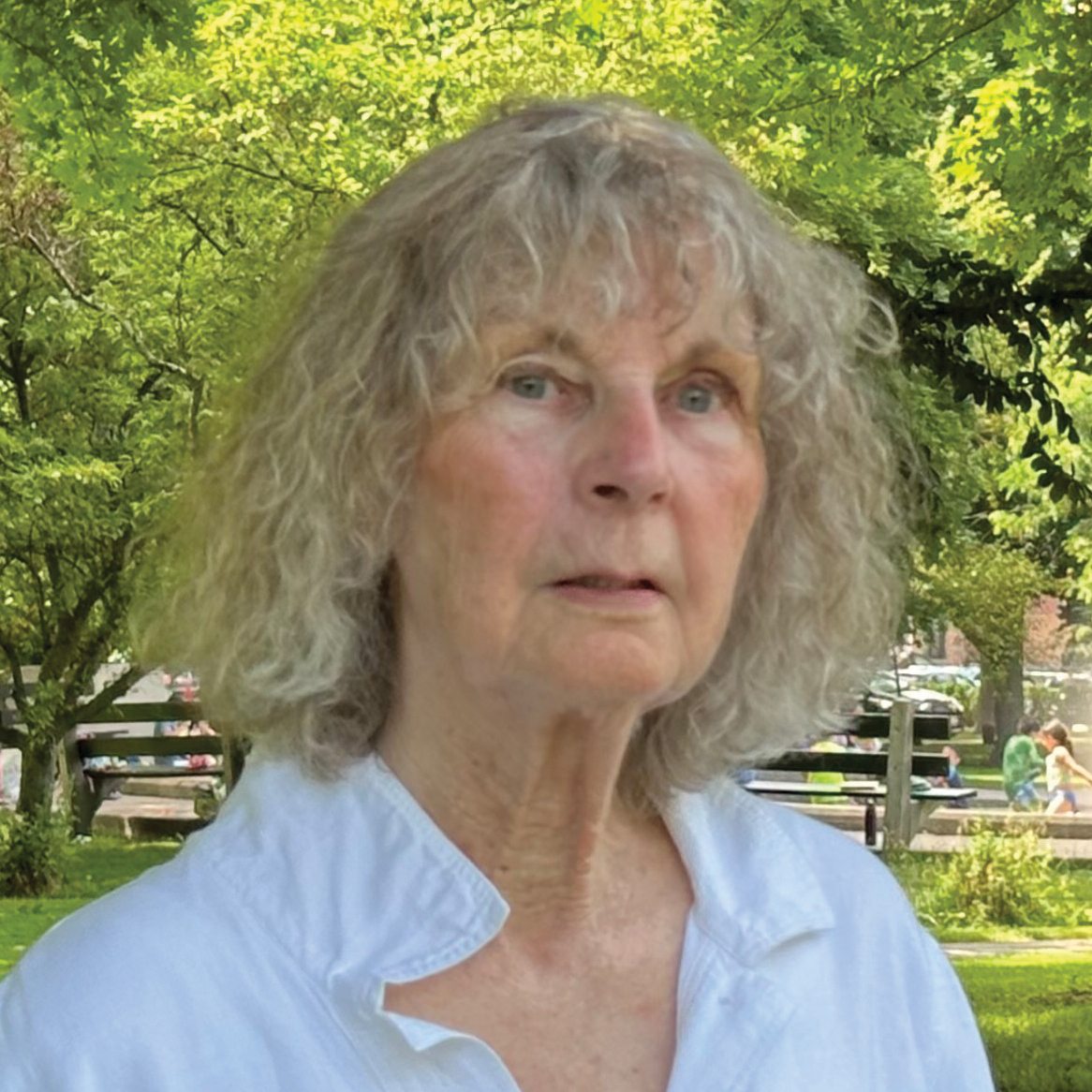
Nancy, who studied and worked in France for 10 years, writes about health, cultural events, food and the healing power of the arts.
How playing music supports brain health as we age
 Fact checked by Derick Wilder
After Fran Freeman retired from working as a speech-language pathologist at an Evanston school, she kept busy. “I was playing tennis, doing Pilates and cardio workouts, and practicing yoga. I was doing a lot to keep my body healthy, but not my brain,” she says.
Then she heard the internationally renowned ukulele player Jake Shimabukuro perform at Ravinia. The concert motivated her to learn to play the instrument.
“The ukulele is easy to learn because it only has four strings, so you can learn a few chords and play a ton of songs,” says Freeman, 75, of Glencoe, Illinois.
By learning the ukulele, Freeman may have picked up more than a hobby. Research increasingly shows that playing music offers protective benefits against memory loss. Even just listening to music helps ease stress and improve mood, according to a University of Michigan National Poll on Healthy Aging. While more than half (56%) of older adults report listening to music daily, 17% of adults ages 50 to 80 report playing music in the past year. And actively playing it could be key to protecting against memory loss.
Robert Wilson, PhD, a neuropsychologist in the Rush Alzheimer’s Disease Center, studies the causes of memory loss and changes in thinking skills in older age.
Wilson makes this connection based on studies that show people with dementia who read regularly developed the disease about five years later than those who were less cognitively active. Wilson says that it’s very likely people learning to play a musical instrument or regularly singing in a choir would show similar results because both are considered cognitively demanding activities.
The joy — and brain boost — of making music
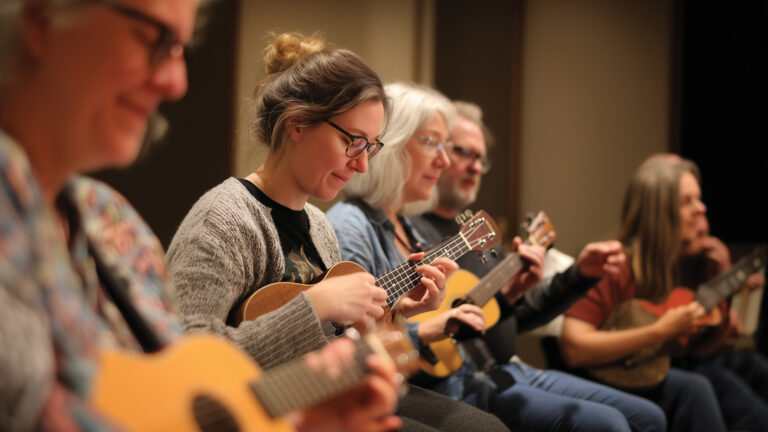
Once Freeman started ukulele lessons, she eventually searched for a group to join. She found one at the Levy Senior Center in Evanston, where 12 ukulele regulars between the ages of 65 and 80 call themselves the Relevant Strummers.
“They learn songs that span 110 years and a wide variety of genres, but the lyrics are all pertinent to the human condition today,” says Lorraine Williams, ukulele instructor at the Levy Center.
Williams says the ukulele is a perfect fit for older adults. “It is small and lightweight, so even people with neck and shoulder issues can easily get an arm around the instrument to hold it.”
She points out that playing the ukulele requires multitasking: “You have to learn the chords, remember them, and find the fingers to play them, read the lyrics for those who sing, and keep the tempo. You have to do several things at the same time, which is good for the brain.”
Freeman recalls breaking her wrist about two years before joining the group. At first, she had trouble reaching the chords with her left hand, but with practice, she succeeded. “I like having a goal,” she says, “because it forces me to practice more when I know I am going to be performing in front of a group.”
Williams says that the ukulele classes are about more than just learning songs. “We laugh a lot and have fun, and the group has a real sense of community,” she says.
Wilson points out that people involved in musical activities benefit from two other protective lifestyle factors. “People who have a high sense of purpose in older age and remain socially engaged and feel connected to others on a sustained basis are less likely to experience cognitive decline and dementia,” he says.
People can also benefit their well-being by joining free, interactive drum circles where no experience is required. “The drum is the heartbeat of humanity,” says John Yost, facilitator of Rhythm Revolution’s monthly event in Chicago. “We all get months of rhythmic training from our mother’s heartbeat in the womb.”
Some participants bring their own drums, while others choose from the drums, shakers, and other percussion instruments that Yost provides. People of all ages come to the circle, and when it meets outdoors in warm weather, some bring their children or grandchildren.
“Some people come because they are lonely, others because they are looking for someone to date,” says Yost, who met his wife at a drum circle. “Others come to tune out after a hard day or because they drive people around them crazy by tapping all the time. Others want to drown out the divisive political language.”
Yost, who has a degree in percussion from Northeastern Illinois University, says, “My role is to get everyone listening to themselves and to the others. The result is guided spontaneous improvisation.”
He adds, “The repetition of the pulsing rhythm connects people to themselves and to others and creates a shared sense of community.”
Building connection and confidence
For singers over age 55, the Sounds Good! Choir doesn’t require auditions and rehearses weekly for 90 minutes. The Chicago area has eight choirs, all led by professional conductors.
Jonathan Miller, artistic director of Sounds Good! and one of the conductors, says some people join the choir because they’ve retired and are looking for structure and routine. Or, for those who have moved to the area to be near family, the choir can be a great place to meet new people.
“They find their place in the choir,” Miller says. Some singers are so enthusiastic that they attend rehearsals for more than one choir each week. “We lovingly call them choir hoppers,” Miller says. There are eight choirs in the Chicago area, and rehearsals take place during the day because many older adults don’t drive at night.
During 15-week sessions in the spring and fall, singers learn eight songs that range from Broadway tunes to spirituals, mostly in English but sometimes (especially during the December holidays) in Hebrew or Swahili.
“We choose songs that are not so easy to learn that singers get bored, but not so challenging that they get discouraged,” Miller says. “Those who are experienced singers support those who are not as strong.”
Miller himself continues to take voice lessons and shares some of the techniques with choir members. “Some singers say they have expanded their vocal range since they joined the choir. The voice is like any muscle: The more you use it, the stronger it gets.”
No matter the type of music a person engages in, participation offers a cognitive, physical, and emotional challenge. And it’s fun, too.
Get in the Groove with One of These Musical Outlets
Levy Senior Center
(847) 448-8250, lscfevanston.org
Old Town School of Folk Music
(773) 728-6000, oldtownschool.org
Rhythm Revolution
(773) 802-0605, drummingcircle.com, or look for drum circles at your local park district
Sounds Good! Choir
(630) 395-9542, soundsgoodchoir.org