
How families should think about disease control when touring assisted living communities
 Fact checked by Derick Wilder
When families begin considering assisted living for a parent or spouse, they tend to focus on the obvious: location, cost, activities, and food. What many overlook, but should not, is infection control.
In congregate settings, where residents share dining rooms, hallways, and staff, a lapse in basic hygiene can quickly escalate. A single case of flu or norovirus can spread facility-wide. For adults in their 70s, 80s, and beyond — many with multiple chronic conditions — that can mean hospitalization or worse.
There’s no shortage of options. Illinois has roughly 600 senior living communities, nearly half in the Chicago metro area. Some, known as continuing care retirement communities, or CCRCs, allow residents to transition to memory care or nursing care on the same campus as needs change. With average assisted living costs in Chicago around $7,350 a month, families need to understand what they are actually evaluating.
“You’ve got to get past the lobby and the marketing,” says Deb Burdsall, an infection preventionist who consults with the Illinois Department of Public Health. “There are some wonderful facilities. But you have to talk to residents and their families.”
Why assisted living is different
Assisted living is regulated at the state level, with no federal oversight comparable to that of the Centers for Medicare and Medicaid Services, which oversees nursing homes, says Afton Johnson, founder of The Care Audit, a platform that compiles state inspection data.
“All 50 states have designated agencies that license and inspect assisted living facilities, but they each set their own standards, inspection frequencies, and enforcement thresholds,” she says. “The variation is enormous. A deficiency that gets a facility fined in one state might not even be cited in another.”
That inconsistency has consequences. During the Covid-19 pandemic, Burdsall consulted with the Illinois Department of Public Health and visited about 200 skilled nursing and assisted living facilities. Many operated on a social model with limited clinical infrastructure and minimal emphasis on infection prevention.
“Assisted living in this day and age is really what nursing homes were like 30 years ago,” she says. “The acuity is much higher than people realize. If residents were well enough to truly live independently, they’d still be at home.”
Memory care units can be especially vulnerable. Residents often live in close quarters, may struggle with hygiene, and receive frequent visits from family members — all of which increase exposure risk.
The most common infections
Several infections are common in assisted living: norovirus, influenza, RSV, and Covid-19. All spread easily in shared spaces.
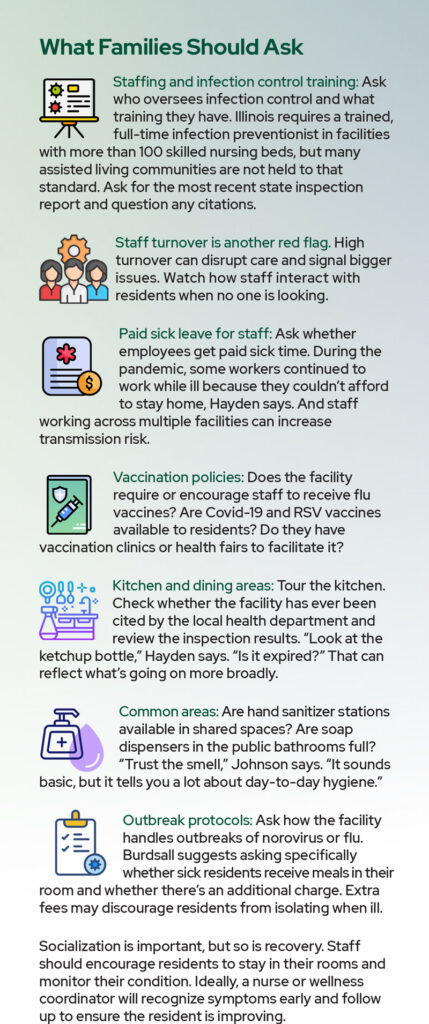 Norovirus is particularly challenging. It spreads through contaminated hands, surfaces, food, and even microscopic particles released during vomiting or flushing. Containment requires strict cleaning protocols and appropriate disinfectants. Alcohol hand sanitizer alone is not enough; washing hands with soap and water is required, says Mary Hayden, MD, director of the Division of Infectious Diseases at Rush University Medical Center.
If a facility cannot clearly explain how it manages norovirus, families should take note.
Respiratory infections also carry broader risks for older adults.
“During flu season, we see more heart attacks,” Hayden says. “The stress of a viral infection in somebody with underlying coronary artery disease can trigger a cardiac event. What looks manageable in a healthy adult can cascade in someone over 75.”
Burdsall saw the consequences during the pandemic. In some facilities, overwhelmed staff and weak infection protocols led to people dying.
“It goes back to whether there’s an organized, functioning infection prevention program — evidence-based policies and procedures, trained staff, and enough time and resources,” she says.
Illinois families can consult the Long-Term Care Ombudsman Program. This state resource advocates for residents and can provide insight into specific facilities beyond what marketing materials or websites will reveal.
A polished lobby and appealing amenities do not guarantee safe care. Asking the right questions can make a difference.
Originally published in the Summer/Fall 2026 print issue.